Build an assembly from cuboids
Use axis-aligned cuboid components to represent enclosures, fins, plates, and channels in your simulation request.
The Python snippets below use a finned heatsink to illustrate how to define individual parts and generate repeated ones. Adapt the dimensions, material properties, and layout to your assembly.
Define individual components
Give every component a unique tag and add it once to cuboid_components. Components may share a face, but their volumes must not overlap.
If several parts share material properties, use a helper function to keep their definitions consistent. For example, this helper creates conducting cuboids and is used to define a heatsink base:
def conducting_cuboid(tag, origin, size, conductivity, power=0.0):
    """Describe one conducting cuboid using aluminum density and heat capacity."""
    return {
        "tag": tag,
        "bbox": {"origin": origin, "size": size},
        "thermal_model": {
            "conducting": {
                "conductivity": conductivity,
                "density": 2700.0,
                "specific_heat_capacity": 900.0,
                "power": power,
            }
        },
    }


base = conducting_cuboid(
    "heatsink-base",
    origin=[0.02, 0.01, 0.005],
    size=[0.08, 0.06, 0.004],
    conductivity=180.0,
)
Use matching face coordinates where conducting parts should be thermally connected. Leave gaps where fluid passages are needed.
Generate repeated components
Use a loop for repeated parts such as fins, ribs, or supports. Make their count, spacing, and starting position parameters so you can change the layout consistently.
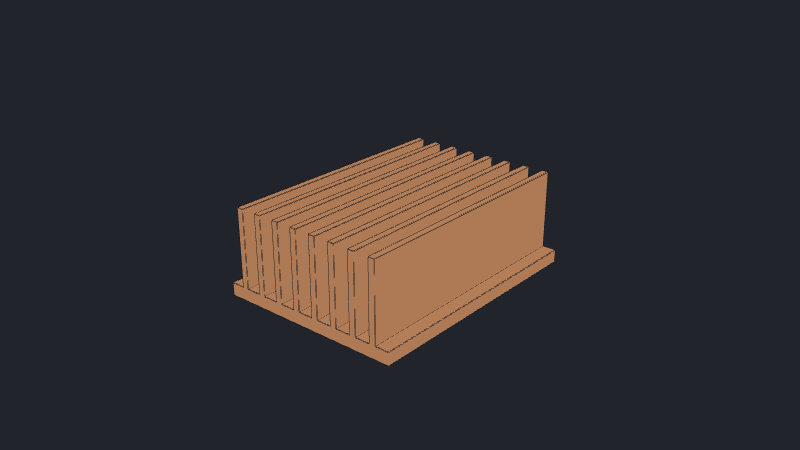
In this example, the loop generates a row of fins and combines them with the base in cuboid_components:
def fins(count, first_y, pitch):
    """Space identical fins along y, with their bottoms touching the base's top face."""
    return [
        conducting_cuboid(
            tag=f"heatsink-fin-{index + 1}",
            origin=[0.02, first_y + index * pitch, 0.009],
            size=[0.08, 0.002, 0.025],
            conductivity=180.0,
        )
        for index in range(count)
    ]


# Center the 51 mm-wide fin array on the 60 mm base, leaving 4.5 mm at each end.
request["cuboid_components"] = [base, *fins(count=8, first_y=0.0145, pitch=0.007)]
Include all fixed and generated parts in cuboid_components, retaining any other components in your request. Check the extent of each array against the domain and surrounding parts. Reject parameter combinations that cause overlaps or close required passages.
The plot below shows the example assembly made from the cuboid snippets above: one base and eight fins.
See also
- Add a cuboid component covers one component and its thermal model.
- Configure the mesh shows how to add refinement around components and gaps.
- Mesh resolution and controls explains fusing, culling, and component cell sizes.